Direct2Care

Derek Kinzer
President, Direct2Care
“You can go with the big agency cruise ship — slow and expensive. You can hire an army of freelance jet skis and babysit every one of them. Or you can get a speedboat: a small, highly tactical team that just weaves through all of it and gets the job done. That’s RevSpark.”
Company snapshot
Company | Direct2Care — affordable, virtual healthcare benefit for franchise and business owners |
|---|---|
Stage | Growth-stage, operating without institutional funding |
Challenge | Website and messaging no longer reflected product maturity, ICP clarity, or enterprise ambition |
Timeline | ~8 weeks production, ~10 weeks including refinement |
Result | Enterprise-ready positioning, stronger investor reception, scalable messaging foundation |
Direct2Care had a website problem. It wasn't broken — everything loaded and the forms (mostly) worked. But the company had outgrown it the way a kid outgrows last year's shoes.
The brand helps franchise and business owners support the well-being of their hourly teams with a virtual healthcare benefit. They serve QSR, hospitality, logistics, and trades, with clients like Chick-fil-A and McDonald’s franchisees already on board.
When President Derek Kinzer reached out to RevSpark in 2025, Direct2Care was already punching well above its weight class. But the website told a different story. The messaging was broad, the design felt dated, and every prospect who landed on the homepage walked away more confused than when they arrived.
We delivered a full messaging architecture, conversion-focused website copy, a modernized design, and a Framer-built site in 10 weeks. Direct2Care walked away with enterprise-ready positioning, a scalable messaging foundation, and a website that drew immediate praise from stakeholders.
The problem
The product worked. The site didn't.
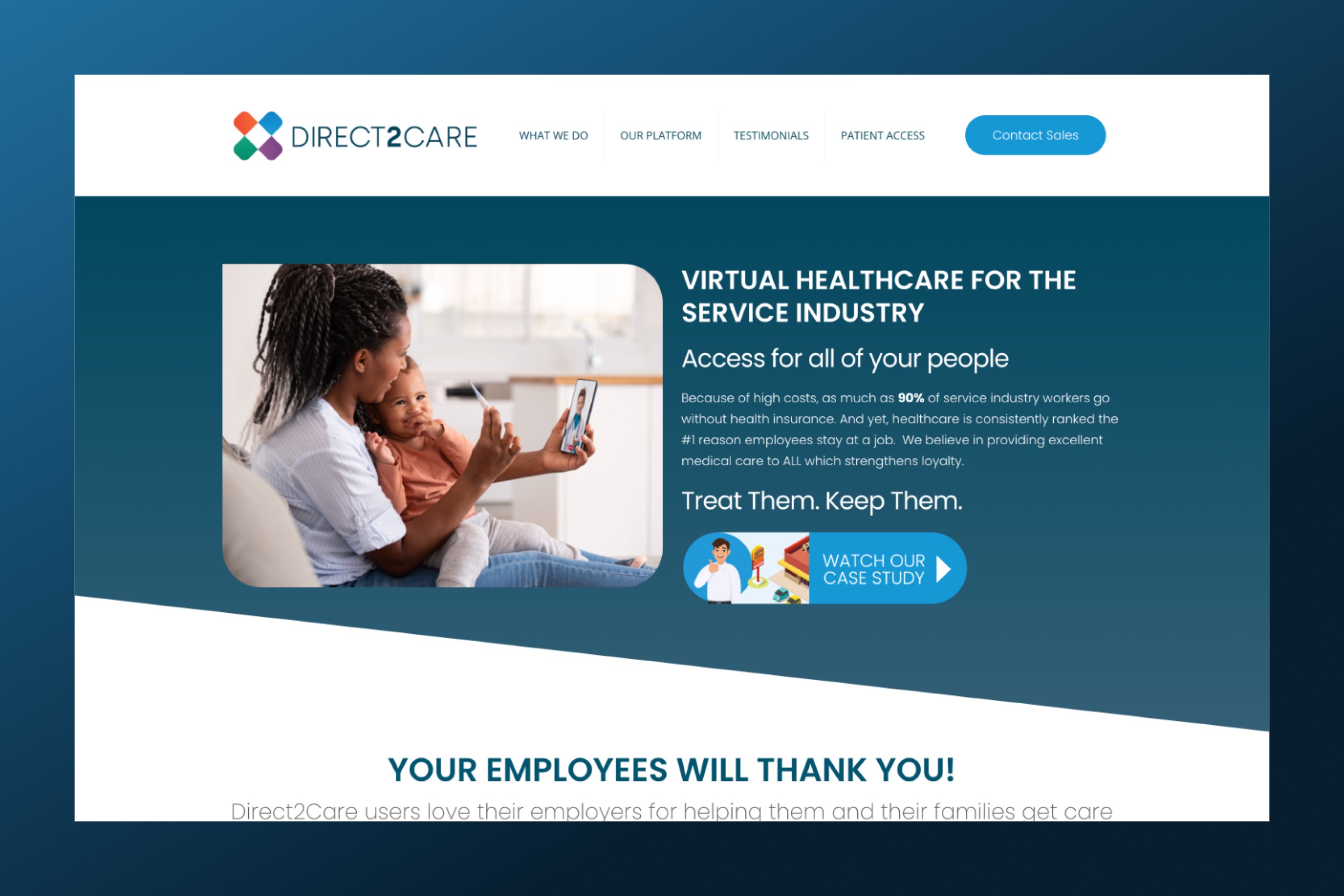
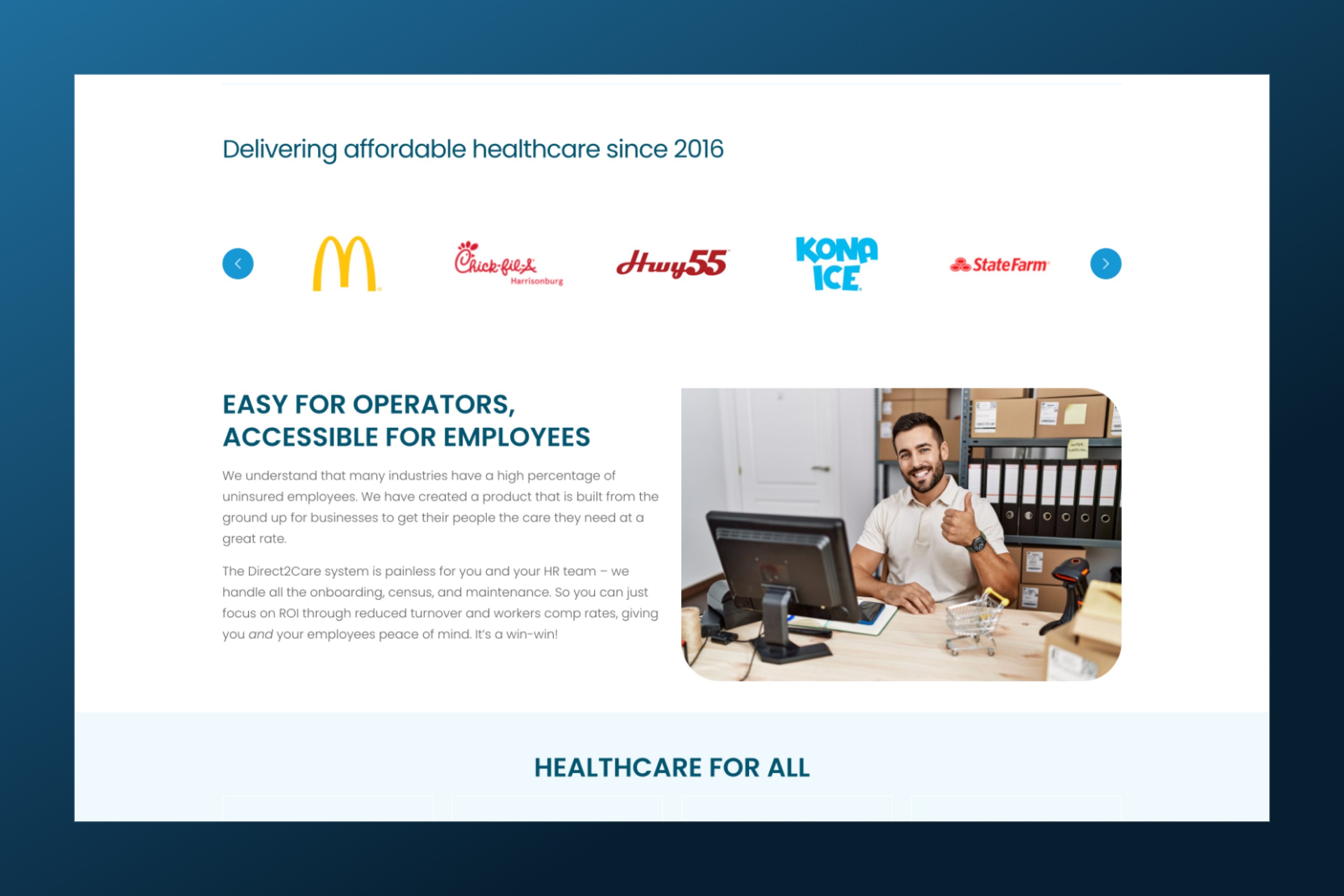
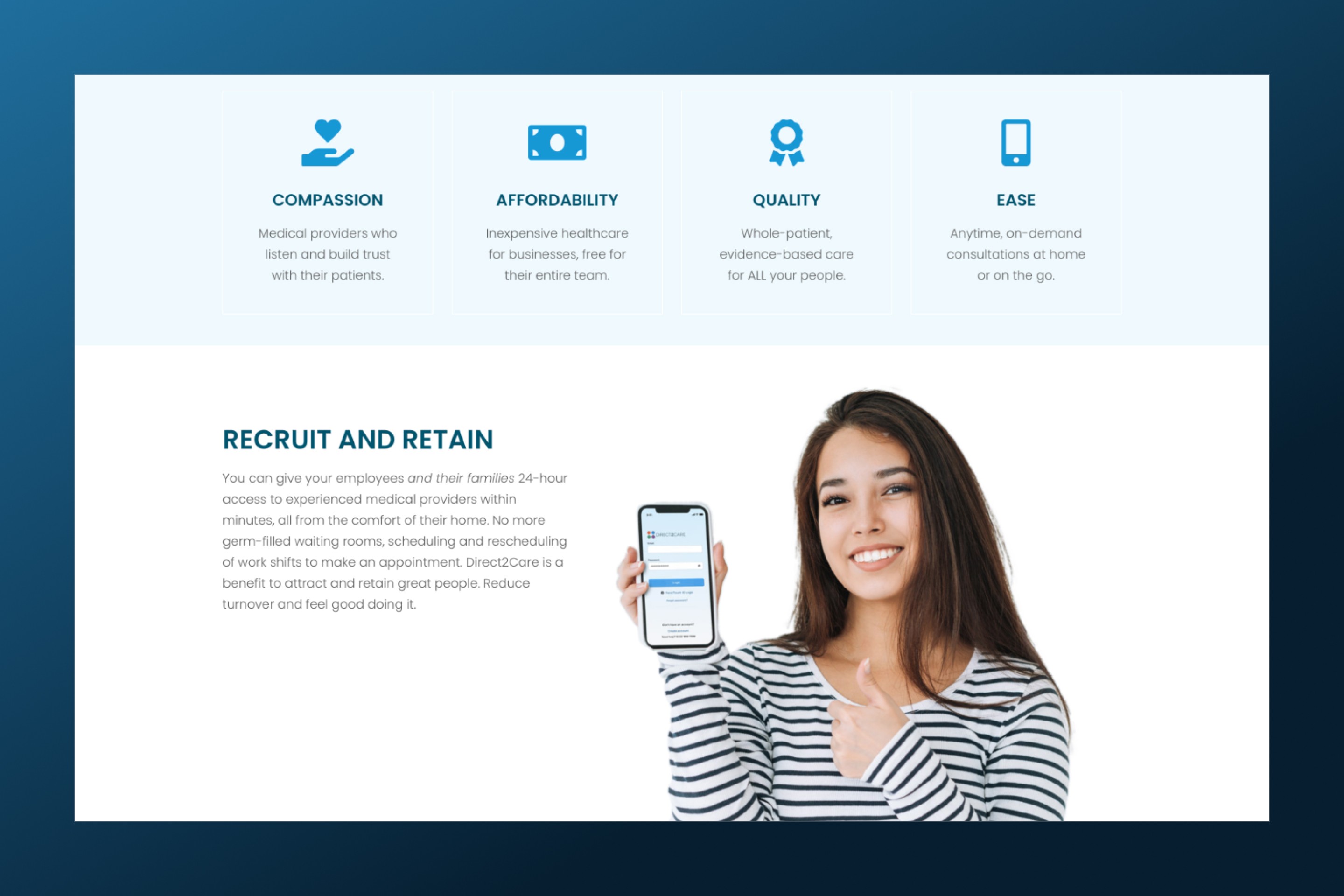
Original website
Direct2Care had earned its momentum. Franchise owners were signing on. The sales team was closing cold calls at a rate most B2B companies would kill for. Everything was working except the thing prospects saw first: the website.
The website messaging described their audience as "the service industry," which doesn't help anyone self-select, and because Direct2Care operates in a healthcare-adjacent space, prospects routinely assumed they were selling insurance. The sales team was spending its best energy on problems the site should have already solved.
Derek knew what needed to change, but his time was stretched across operations, sales, and strategy. He needed a trusted team that could take the vision out of his head and build it.
The constraints
Every project has them. Derek had the background and ability to do the work, but he didn’t have the time—a story familiar to many growth-stage businesses. His worst-case scenario? Spending all of his time directing (or redoing) the work after paying someone else thousands to do it.
Derek’s search felt like a game of extremes. On one hand, agencies quoted as high as $100,000 and offered way more services than he needed. On the other hand, freelancers could handle the individual pieces of the project (copy, design, development), but needed oversight and project management—time Derek couldn’t afford.
What he needed was speed and competence under one roof: a team that could absorb the complexity of his business and move fast, while still delivering great work.
We offered that third path: a small, senior team where strategy, copy, design, and development moved as a single unit with direct access to the people doing the work.
Derek put it better than we could:
“You can go with the big agency cruise ship—slow and expensive. You can hire an army of freelance jet skis and babysit every one of them. Or you can get a speedboat: a small, highly tactical team that just weaves through all of it and gets the job done. That’s RevSpark.”
The RevSpark process
This project gave us a chance to test our 10-week process. Denny carefully managed our process to ensure we married speed and expertise to deliver an enterprise-level website.
1. Strategic alignment
Objective: Translate existing clarity into a direction the website could support.
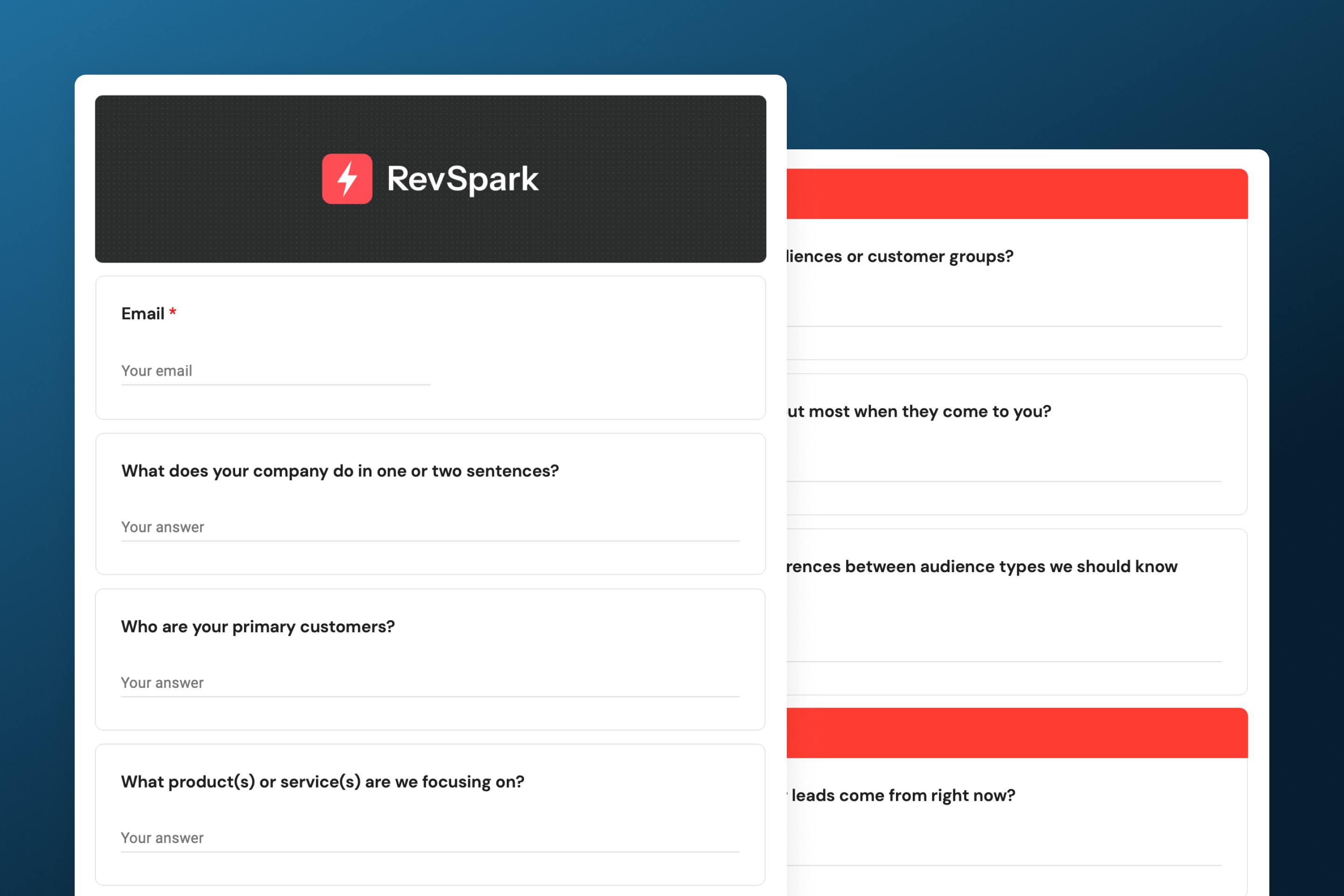
Direct2Care came into the project with a clear understanding of its product, its audience, and where the business was headed. The website just hadn’t kept pace. It didn’t reflect how Direct2Care was being sold, how it was being used, or how the team talked about the business day-to-day.
We started with a pre-discovery questionnaire, then dug deeper. Derek and the team gave us valuable access to assets and insights, including:
The existing website
A current sales deck
A recorded sales call
A working session with the sales leader
Several 1:1 conversations with Derek
Reviewing these materials revealed gaps between how Direct2Care actually worked and how it was presented online. A few patterns emerged quickly:
The product was frequently mistaken for insurance
Sales conversations spent time correcting assumptions
Strong differentiators showed up in live selling, not on the site
Industry-specific language created faster recognition than general employer messaging
As Derek put it:
“We know who we are now, and the website doesn’t reflect it.”
Live working sessions helped close that gap. Derek preferred talking things through in real time, especially when nuance or tradeoffs were involved. These sessions made it easier to pressure-test phrasing, sharpen definitions, and pick priorities.
This stage focused on bringing the website up to speed with the business, making implicit knowledge explicit.
By the end of discovery, the direction was clear. The website had a job to do, and the team agreed on what that job was.
Outputs
Strategic notes from live sessions
Clear positioning direction
“What we are/what we are not” framing
Inputs that directly informed messaging architecture and copy decisions
This work set the pace for the rest of the project. Once the site’s role was clearly defined, everything that followed moved with more focus and fewer course corrections.
2. Messaging architecture
Objective: Give the company a shared language that could scale beyond the website.
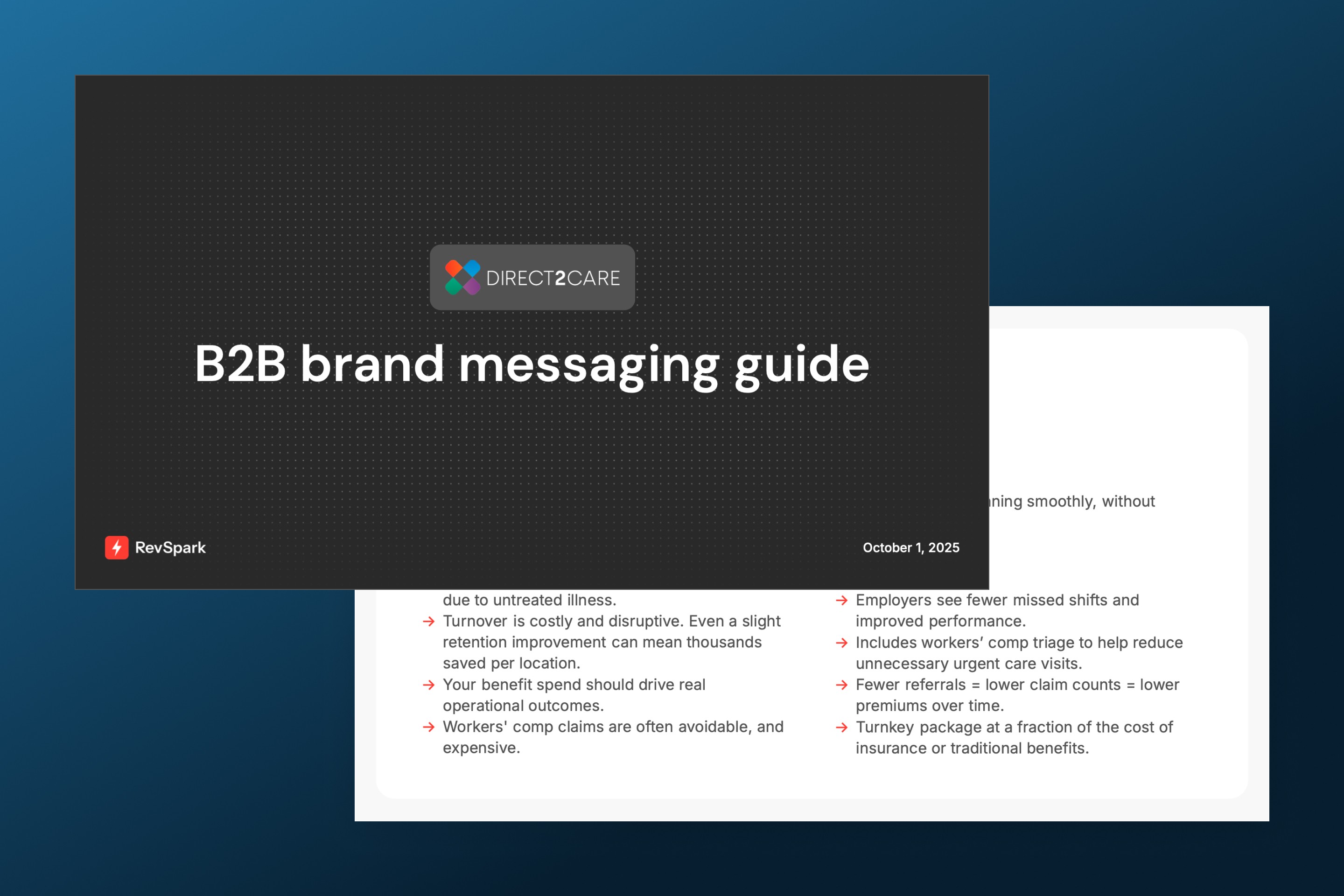
The raw material wasn’t invented from scratch. We merely translated the D2C messaging. Derek and the sales team already knew how to talk about the businesses. Our job was to collect that language, give it structure, and turn it into a framework the company could use everywhere.
Rebecca delivered a full B2B brand messaging guide covering positioning, pillars, value propositions, tone of voice, competitor analysis, and industry-specific angles.
The most critical piece was differentiation. Direct2Care needed to get away from insurance comparisons, and it couldn't exist only in the FAQ. We had to find ways to talk about the brand in a way that reinforced this across every page.
This even influenced how we named the service categories. We went back and forth on what to call their core medical offering. “Primary care” felt too close to traditional insurance language, and “essential care” was vague. We landed on “everyday healthcare,” which was clear, accessible, and didn’t accidentally position them in territory they were trying to avoid.
That word-level decision may seem small, but it shapes how every prospect (and end-user) understands the service.
We also struggled internally with industry segmentation. How much did we want to single out the core quick-service restaurant (QSR) audience on the home page? Do we speak directly to them, even at the risk of narrowing the prospect pool?
For us, specificity trumps generalization. The resolution was strategic: lead with QSR now, and build additional dedicated industry pages over time.
Outputs:
B2B brand messaging guide
Positioning and elevator pitch
Five messaging pillars with supporting language
Industry-specific messaging angles (QSR, hospitality, logistics, trades)
Tone of voice guidelines
When Derek reviewed the guide, there wasn’t a dramatic pivot moment. It was recognition. He said the business described the way he’d wanted to but hadn’t had the time to pull off.
3. Website copy
Objective: Write conversion-focused copy that walks prospects through the entire journey, from “what’s this” to “let’s talk,” before the sales team even gets involved.
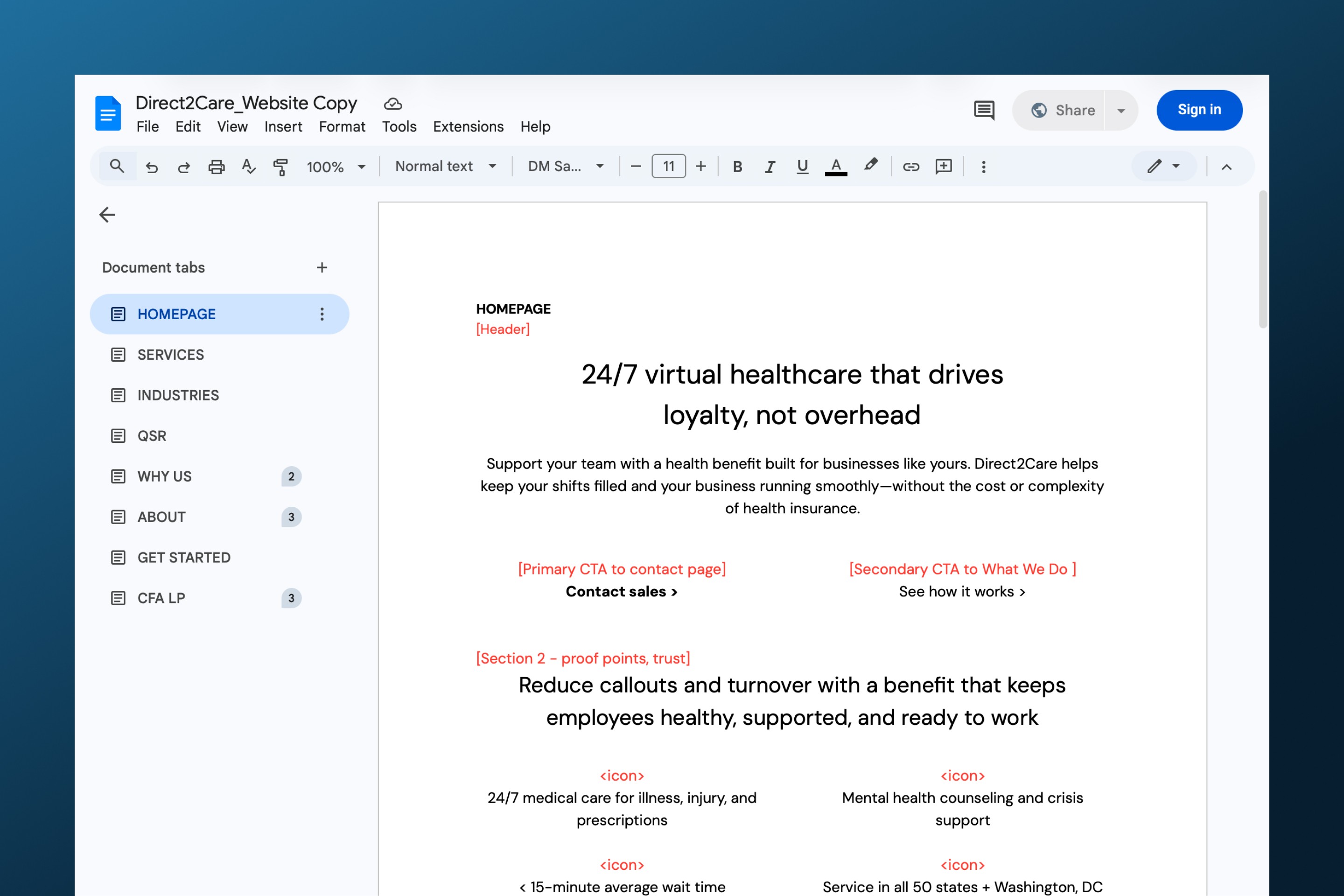
The old site spoke in generalities. We got specific by putting the new messaging architecture to work.
The copy needed to do three main things:
Eliminate confusion around what they do (and what they don’t) early
Reinforce Direct2Care’s unique offering for QSR franchises and other businesses
Get franchisees and business owners to recognize Direct2Care as a worthy benefit to offer their employees
Now, the homepage opens with a scenario franchise operators have lived a hundred times: an employee gets sick, can’t afford urgent care, powers through it, ends up in the ER with an $1,800 bill, and starts looking for a new job to help cover the cost.
That kind of narrative does more positioning work than any tagline could. It tells the reader: we understand your world, and here’s what we can do about it.
The copy also addressed the insurance confusion head-on. Language across every page makes it clear that Direct2Care is a telehealth benefit, not an insurance product. No copays, no waiting periods, no admin complexity. That clarity takes real weight off the sales team and lets conversations start from a better place.
While copy was being written, rough wireframe decisions were happening in parallel—how many sections, what order, how long each block needed to be, etc. Our designer could see the structural intent early and flag anything that wouldn't work visually before we were too far down the road.
Outputs
Full sitemap refinement
Conversion-focused homepage
Industry-specific service and solution pages
Clear differentiation of language embedded throughout
Scannable page structures built for executive buyers
After launch, Derek used the messaging framework to update several sales materials on his own. The language translated beyond the site and influenced other marketing efforts.
4. Design
Objective: Modernize the brand while maintaining the original logo and brand elements.
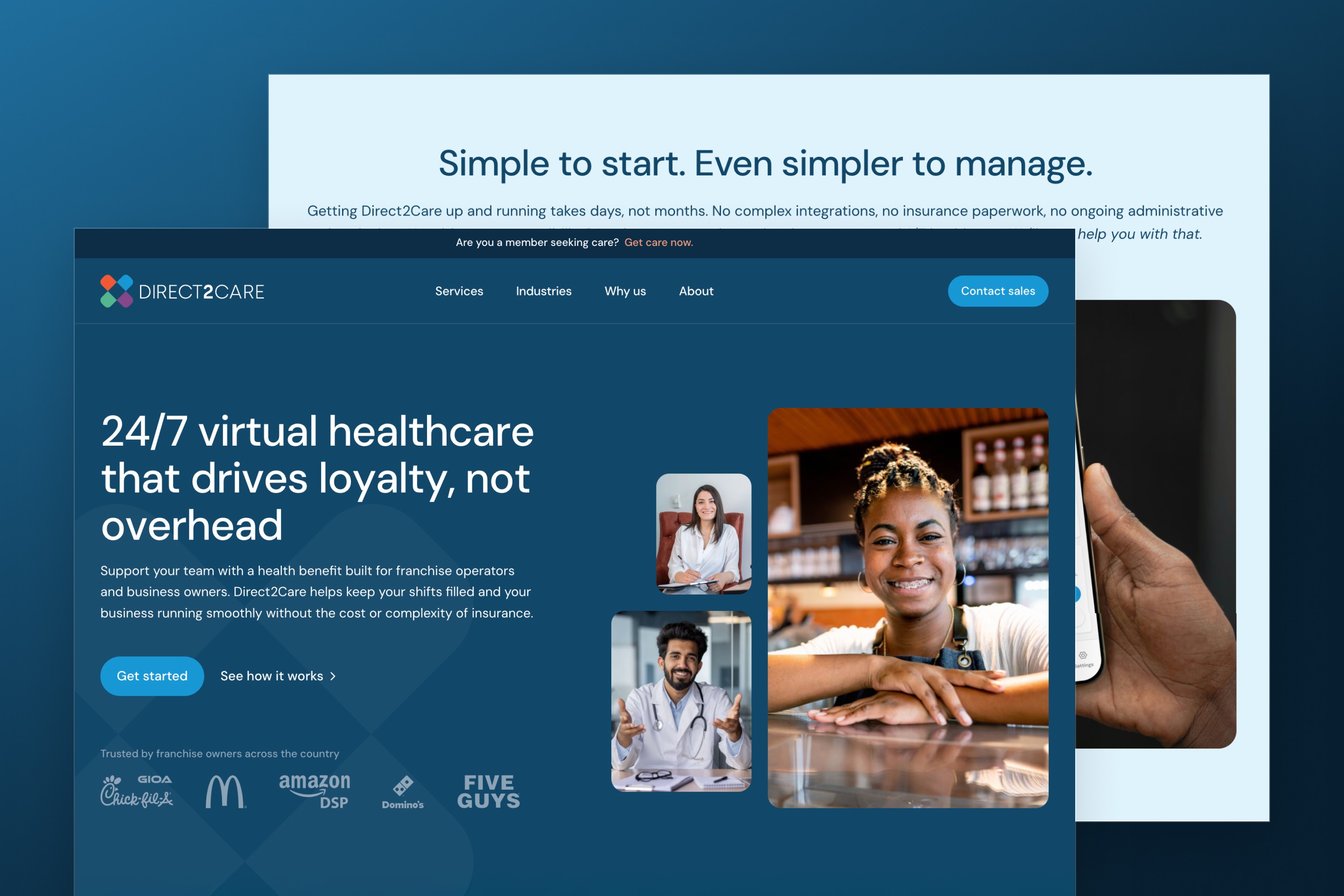
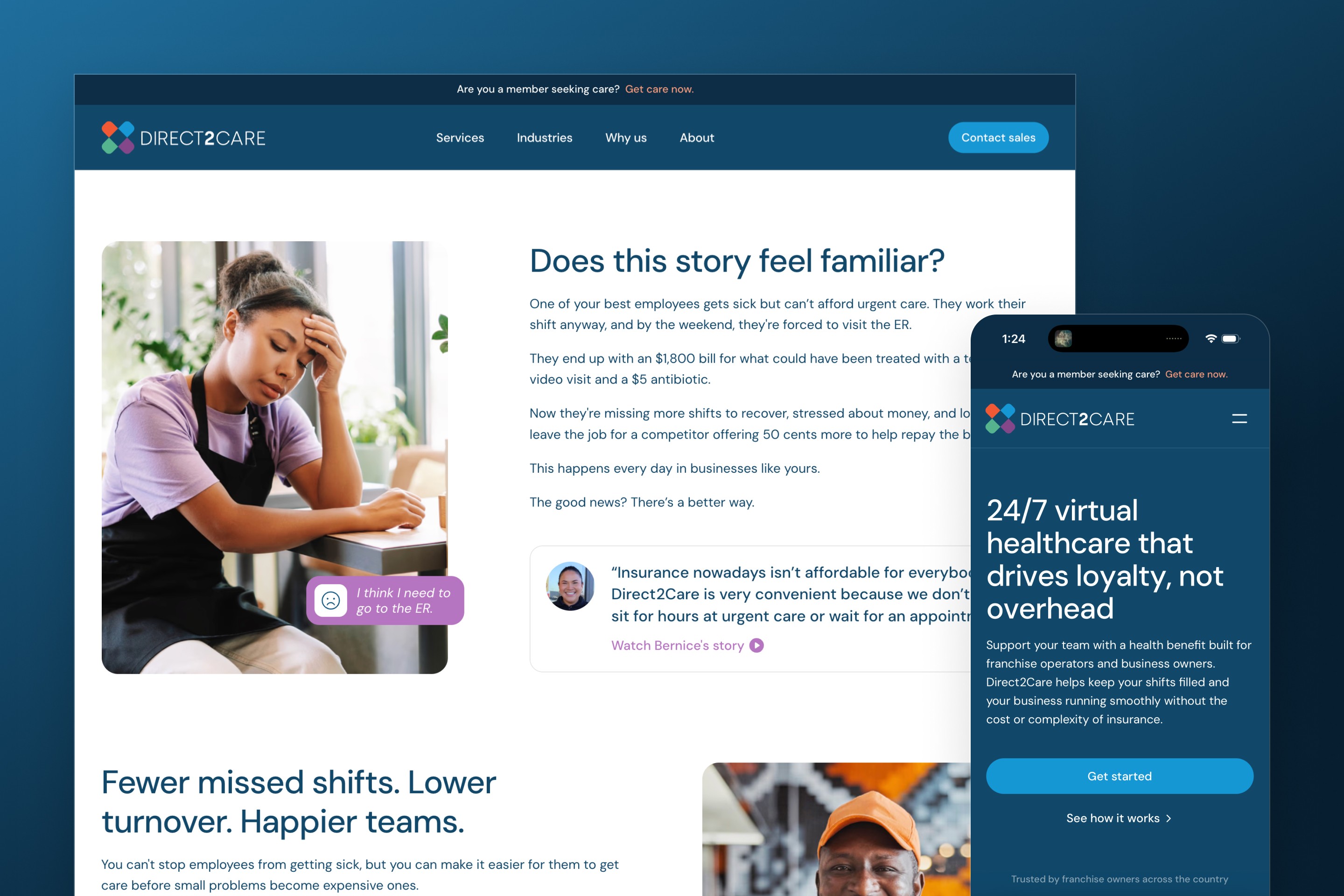
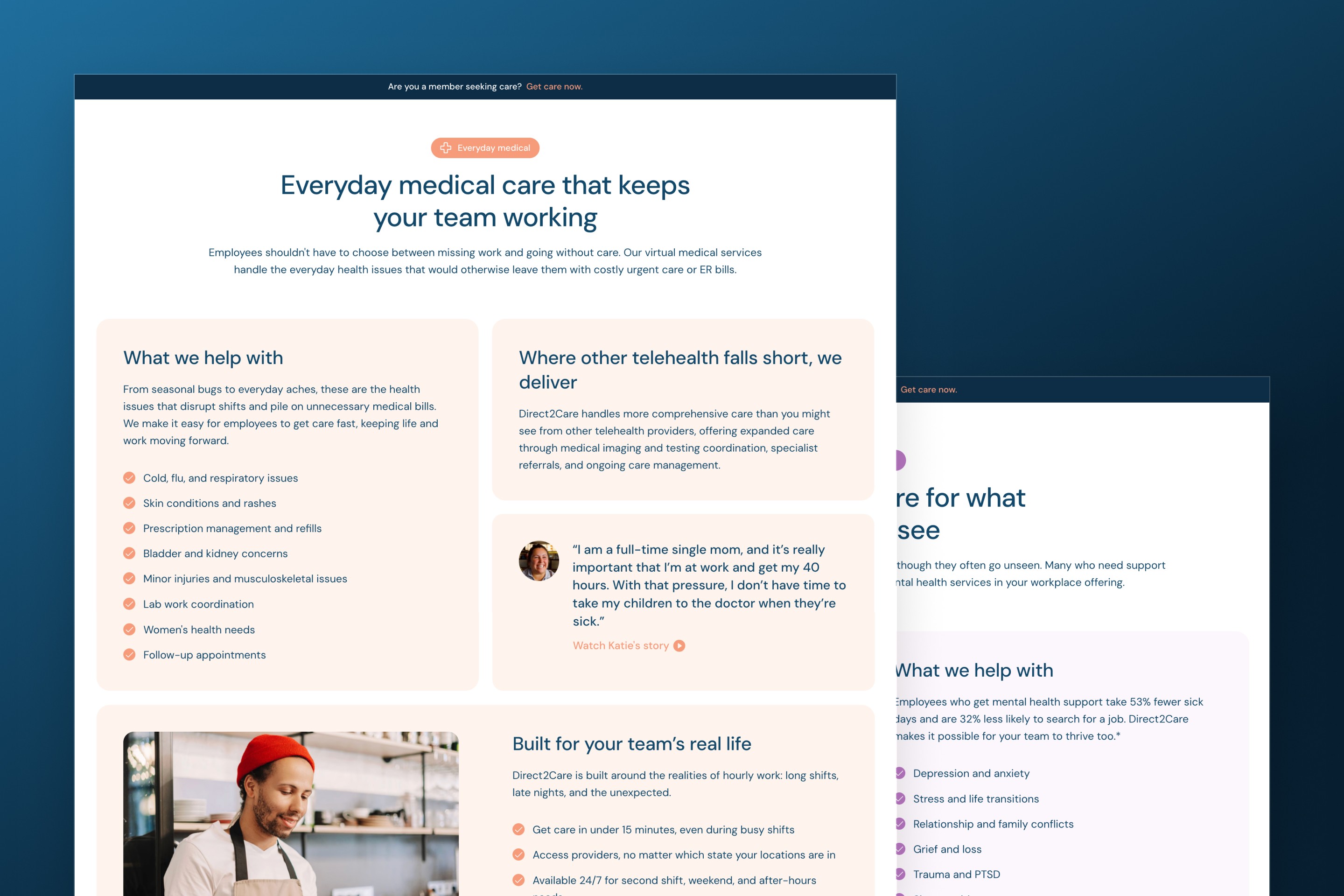
Design’s biggest challenge was reinventing the website without launching into a full rebrand. Derek wanted to keep the current logo and colors while modernizing the design. We needed to elevate the perception without disrupting the brand equity.
We focused on:
Clean layout systems
Clear hierarchy
Improved typography
Using color more strategically
Adam picked up the wireframe structure from the copy phase and started translating it into layouts. Because he'd been on strategy calls from the beginning, he wasn't designing in a vacuum—he already understood the messaging hierarchy, knew which sections carried the most weight, and could make visual decisions that reinforced the story the copy was telling.
Once layouts were approved, copy and design came together for a final pass. Where copy ran too long for a section, we trimmed it. Where a section needed a CTA that wasn't in the original draft, we wrote one. That back-and-forth is built into how we work—it's not a revision cycle, it's the process.
"You put the old site next to the new one, and you just go, 'How did we wait so long to do this?' The jump in professionalism was immediate."
— Derek Kinzer
Outputs
Refined design systems within existing constraints
Homepage and interior page designs
Visual hierarchy optimized for scannability
5. Development
Objective: Build a site that Direct2Care can manage and that can grow with the business.
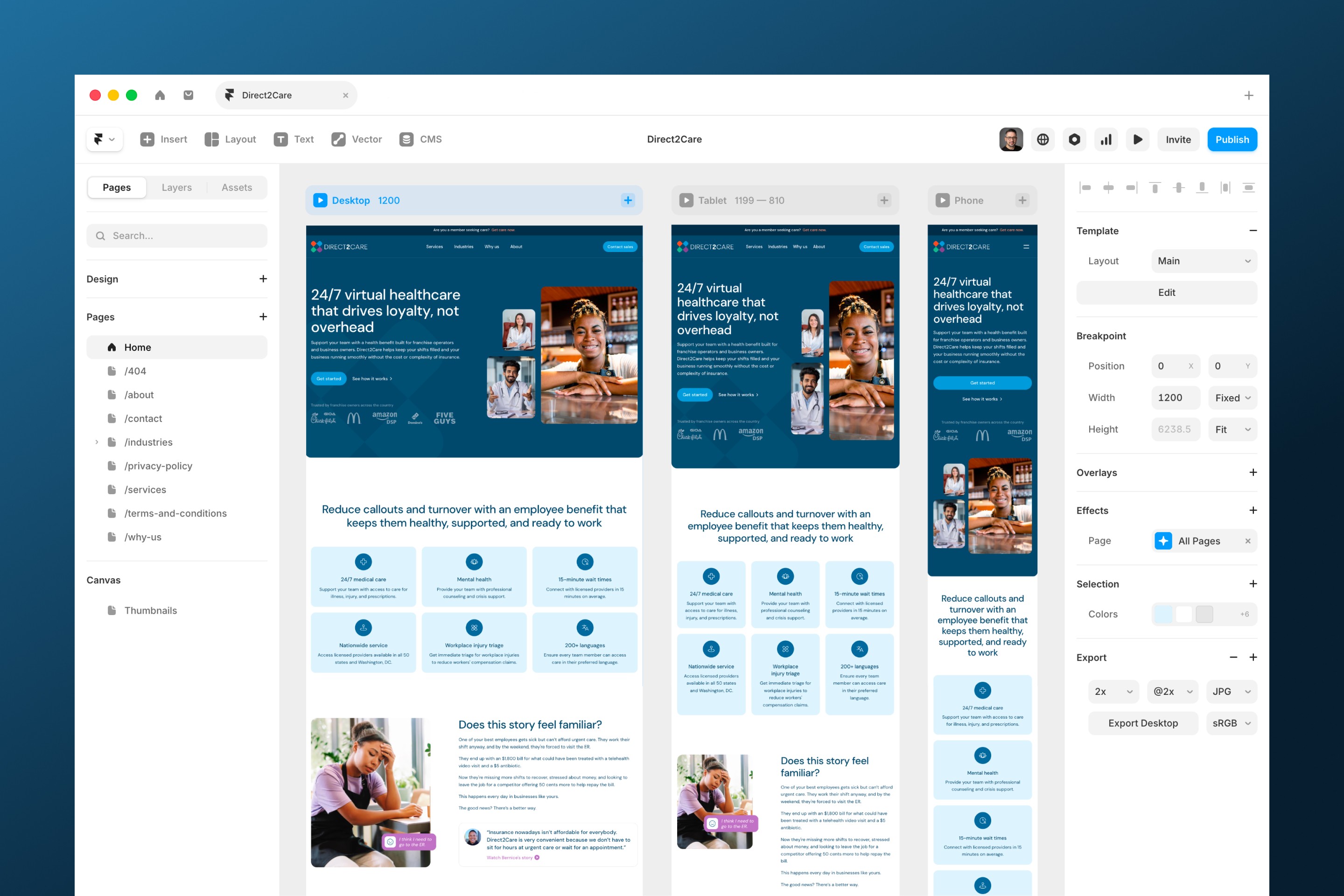
The previous site lived in WordPress. It functioned, but it wasn’t easy for the Direct2Care team to update it on their own.
We migrated Direct2Care to Framer to support:
Faster iteration
Cleaner architecture
Easier future page expansion
Reduced technical overhead
For this project, Framer's page-based architecture was especially important. Direct2Care plans to add dedicated industry pages, landing pages, and content sections over time. The site is designed to evolve, not be rebuilt every 18 months.
We also integrated HubSpot on the backend to support Direct2Care's future marketing efforts—forms, tracking, and automation were ready from day one.
Outputs
Fully built Framer site replacing WordPress
HubSpot integration for marketing automation
Page-based architecture to ease future expansion
A platform the team can grow into as their marketing capacity scales
When the site went live, Direct2Care had a platform that could finally keep pace with the business—and the flexibility to keep building on it.
Why we build in Framer
One system, end to end. Design, content, and publishing happen in one place. No handoffs, no bottlenecks.
Scales without rewrites. Add pages, sections, and content without rebuilding the architecture.
Edit directly on the page. Content changes happen visually, in real time, without developer support.
Built-in SEO and analytics. Clean markup, fast performance, and A/B testing out of the box.
Extends with your stack. Built on React, Framer integrates with tools like HubSpot, Google Analytics, and more.
The outcome
A few weeks after launch, Derek pulled up the new site at a gathering with investors. The feedback was universally positive. One of the people in the room was the developer who had built the original website, and even he was impressed.
Internally, the messaging guide became a working document almost immediately. Derek started rebuilding sales collateral and conference materials off the framework. The team finally had a shared language for describing what they do.
The site is doing exactly what Derek envisioned: functioning as a sales tool. Prospects who land on the website understand what Direct2Care does, who it's for, and why it matters—before picking up a phone.
Derek is now planning new pages, continued expansion, and a full marketing strategy for the year ahead. He even asked to partner with us for additional marketing projects as the business grows.
Final thoughts
This project represents a specific kind of company at a specific kind of moment.
Product-market fit is established. Growth is accelerating. Buyers, investors, and partners are paying closer attention. The business has evolved, and the website hasn’t fully caught up.
We know how to maximize this inflection point.
It’s about alignment. Ensuring external signals reflect internal momentum. Giving the business a front door that matches the level of conversation already happening behind it.
We’re a small, senior team. Strategy, messaging, design, and development move together. We pressure-test decisions. We disagree openly. We care about getting it right.
As Derek put it:
“I watched them disagree with each other in front of me—and that’s when I knew they actually cared about getting it right, not just getting it done.”
Direct2Care didn’t need reinvention. They needed clarity. Precision. A website that could carry the same weight as their growth.
That’s the kind of moment we’re built for.